

Have you ever heard the term supercompensation?
After all, it is the most important concept in endurance sports, whether you are a runner, triathlete, or cyclist! Supercompensation is the process responsible for improving our performance capacity.
Supercompensation is one of several training principles in sports. Simply put, supercompensation is the principle of an optimal relationship between load and relief, or recovery.
The Process of Supercompensation Explained
Our body does not develop during physical exertion, but in the period afterward, when we allow our body to rest. This is where the so-called supercompensation effect comes into play. Only if we choose the right balance between stress and regeneration will we improve.
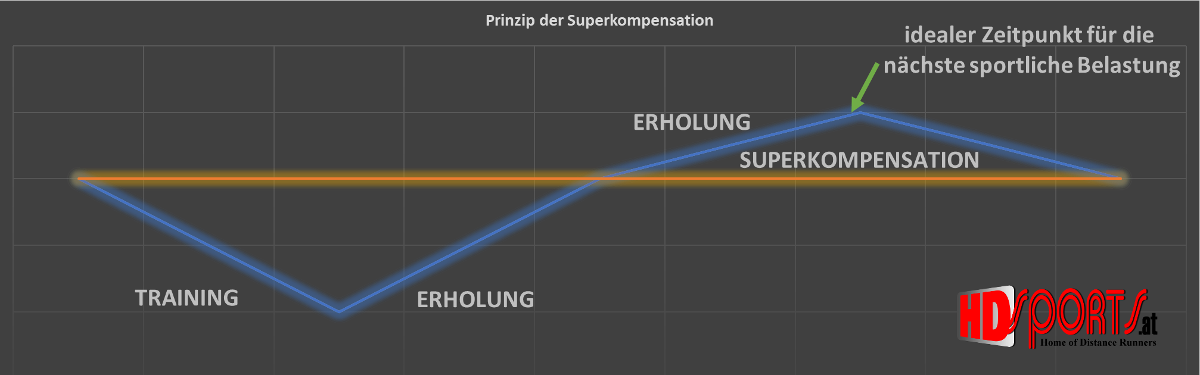
If the break is too short, we enter a state of overtraining. The result is usually a decline in performance and a deterioration in performance capacity. One might now say that we should rest as long as possible. But that is not correct either. If the break is too long, our performance capacity returns to its original level. Therefore, the process of supercompensation can be imagined as a kind of performance curve: Shortly after training, the curve drops below the performance level (because we are fatigued), then the curve rises and exceeds the original performance level.
At this point, the next physical stress should follow. After a certain amount of time, the performance curve begins to flatten before returning to the initial level. If this happens, the period between the two training loads was too long.
The Problem with the Principle of the Optimal Relationship Between Load and Recovery
However, the process of supercompensation is very complex, as the recovery duration of the body’s functional systems varies greatly. For example, the repair of damaged mitochondria takes about two to eight days, while other systems can regenerate much faster.
Practical Application
What does supercompensation mean in practical training? Even though the model does not function exactly as it is graphically represented due to the different recovery durations of our body systems, it clearly shows that recovery is the fundamental basis for athletic development. This means that we can train as intensely and purposefully as we want, but if we do not choose the correct duration of recovery, we will not improve.
The supercompensation curve therefore clearly demonstrates why breaks that are too short can actually reduce performance capacity and why breaks that are too long between physical activities also do not lead to performance improvements.



Kommentar schreiben