

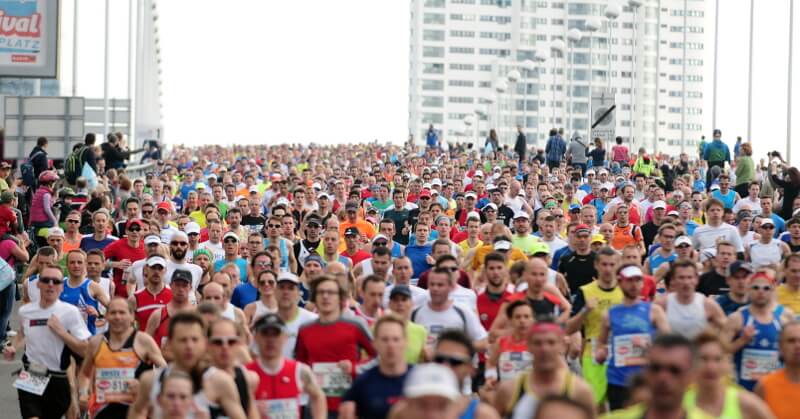
Have you ever wondered why most marathon runners are so slim?
Well, simply put, there are two reasons: On the one hand, every kilogram less that you carry over a distance of 42.195 kilometers reduces energy expenditure. Therefore, you can run at the same pace with less effort if you weigh less. On the other hand, marathon training itself makes you slim, or at least helps you stay lean.
Interesting: Male Marathon Runners Are Surprisingly Short
It is not only body weight that may play a decisive role in marathon running but also height. This is particularly evident among the fastest marathon runners in the world. As of April 2022, six marathon runners have completed the distance in under 2:03 hours. They are all below average in height (*):
| Athlete | Best Time | Weight | Height | BMI |
|---|---|---|---|---|
| Eliud Kipchoge | 2:01:39 | 52 kg | 167 cm | 18.6 |
| Kenenisa Bekele | 2:01:41 | 56 kg | 165 cm | 20.6 |
| Birhanu Legese | 2:02:48 | 55 kg | 168 cm | 19.5 |
| Mosinet Geremew | 2:02:55 | 55 kg | 174 cm | 18.2 |
| Dennis Kimetto | 2:02:57 | 55 kg | 171 cm | 18.8 |
* Exact data for Titus Ekiru (2:02:57) are not available.
With the exception of Bekele, all athletes have a BMI below 20. The WHO classifies a BMI between 18.5 and 25 as normal. Therefore, all athletes are at the edge of underweight or already in the "light underweight" range (BMI 17 – 18.5). However: None of the runners are excessively thin. And not without reason: a world-class marathon runner covers over 200 kilometers per week in specific marathon training and still performs strength and stability exercises. Fat is significantly reduced while muscles are strengthened. Because muscles weigh more than fat, targeted marathon training rarely results in weight loss, at least when eating a healthy and balanced diet.
Height can also be explained simply: taller people usually weigh more (if BMI is constant), and carrying more weight over a long distance is disadvantageous. Therefore, it is not surprising that the fastest marathon runners in the world are all relatively short.
Can Marathon Runners Build Muscle?
Marathon runners do build muscles, but not in the way sprinters or strength athletes do. Long-distance running does not require large or strong muscles but rather endurance muscles. The muscle growth of a marathon runner is therefore very different from that of a sprinter.
Can Marathon Runners Gain Weight?
During marathon training, body weight usually changes only minimally, and mostly downward. The high training volumes lead to enormous calorie expenditure, which must and is balanced with increased calorie intake. Otherwise, the body lacks energy for future sessions. Therefore, especially after long or intense runs, it is important to provide the body with enough carbohydrates (avoid low-carb during marathon training) and protein.
Most weight loss occurs during the marathon itself due to sweat loss, which reduces body weight through water loss.
Gaining weight through marathon training is nearly impossible!
Critical BMI for the Best Women in the World
It is interesting to compare the fastest female marathon runners with the fastest male marathon runners. Let's consider the six fastest female marathon runners of all time (as of April 2022):
| Athlete | Best Time | Weight | Height | BMI |
|---|---|---|---|---|
| Brigid Kosgei | 2:14:04 | 50 kg | 170 cm | 17.3 |
| Paula Radcliffe | 2:15:25 | 54 kg | 173 cm | 18.0 |
| Mary Keitany | 2:17:01 | 42 kg | 158 cm | 16.8 |
| Ruth Chepngetich | 2:17:08 | 48 kg | 165 cm | 17.6 |
| Peres Jepchirchir | 2:17:16 | 43 kg | 160 cm | 16.8 |
| Yalemzerf Yehualaw | 2:17:23 | 50 kg | 169 cm | 17.5 |
What is immediately noticeable for the women is that the BMI is significantly lower. Two athletes are already in the "moderate underweight" range (16.0 – 17.0). Below a value of 16, the WHO recommends inpatient care. Interestingly, female marathon runners have "normal" height, whereas male world-class runners are all short. The two fastest female marathon runners are 170 cm and 173 cm, which is taller than the two fastest male marathon runners.
Looking at the best runners in the world, one could conclude that small men have an advantage, while women need a low BMI to achieve world-class performance.
Conclusion
Yes, to be a fast marathon runner, you must be slim. However, most professionals are at "normal weight" or only "light underweight", which is not a health concern. The reason runners are usually slim is the high calorie expenditure (reduces body fat) and the fact that, unlike sprinters or strength athletes, significantly less muscle mass is built.
Regarding the ideal weight, BMI should be used as a guide: it should be in the lower range of normal weight (BMI 18.0). Then health is not at risk, and maximum marathon performance can be expected.



Kommentar schreiben